|
Radiation
Detection Basics
Since our instruments are sometimes purchased
by individuals with no background in radiation
protection, we thought it would be helpful to
include this information. The following information
is based on features that are available with
most of our Radiation Alert® meters.
For a list of common terms and definitions,
please visit the Health
Physics Society's "Radiation Terms,
Definitions and Fact Sheets"
page on their website., RadWaste.org
or take a look at S.E.
International, Inc's Radiation Basics
Powerpoint Presentation. For information
about State Radiation Protection Programs,
click
here to see a list by state from the CRCPD.
A Brief Overview
of Radiation Detection
None of the instruments listed in this website
detect neutron, microwave, RF (radio frequency),
laser, infrared, or ultraviolet radiation. All
of the instruments are most accurate for Cesium
137 and isotopes of similar energies. Some isotopes
detected relatively well are Cobalt 60, Technicium
99M, Phosphorous 32, Strontium 90, and many
forms of Radium, Plutonium, Uranium, and Thorium.
Some forms of radiation are very difficult
or impossible for a Geiger tube to detect. Tritium
is a byproduct of a nuclear reactor and is used
in research. The beta emissions from Tritium
are so weak that there are very few instruments
that are capable of detecting it. More sophisticated
equipment is needed for the measurement of environmental
samples, such as radioactivity in milk, produce,
soil, etc., unless you are looking for gross
contamination.
The radiation from some isotopes can cause
a Geiger tube to overexcite and indicate a higher
level of radiation than is actually present.
Americium 241 is an example of this phenomenon.
Americium 241 is used in some smoke detectors
and many different types of industrial density
and flow meters.
Unless you know exactly what you are measuring
and understand the limitations of detection
instruments, it is possible to draw misleading
conclusions from your readings. We design our
instruments to detect the broadest range of
ionizing radiation possible and still be affordable.
The full spectrum of ionizing radiation cannot
be measured by one single instrument. Everyone
agrees that radioactive materials can be dangerous.
We encourage you to seek out other sources of
information.
Are any of SE International's
products suitable for neutron detection?
Not currently. Neutrons are too high of
an energy and too fast for standard GM tubes
to detect. Neutrons need to be slowed down in
order to detect them using a (BF3) boron trifluoride
(uses a neutron to alpha particle conversion
to get a measurement)or a High Pressure Helium
3 probe (uses a neutron to positron conversion
to get a measurement).
Can your instruments
detect microwaves?
No. Our instruments detect ionizing radiation.
Microwaves are non-ionizing radiation. DO NOT
PLACE OUR INSTRUMENTS IN A MICROWAVE AS IT MAY
DAMAGE THE INSTRUMENT OR THE MICROWAVE OVEN.
Can your instruments
detect Radon?
Technically, you can use the kusnetz
method or the tsivoglou
method with our instruments for radon
detection, however, these tests should
be preformed by a trained professional.
There are much more practical commercially
available tests for detecting radon. These
are available at many home improvement
stores, or you can contact your local
RSO or Radiological
Health Department for more information.
Common Conversions
and Prefixes
|
1 µCi = 37 kBq
1 mCi = 37 MBq
1 Bq = 27 pCi
370 MBq = 10 mCi
1 µSv = 0.1 mrem |
Roentgen,
represented by "R", is
the unit of measurement that indicates
the charge produced in air by x
or gamma rays, whereas SI Units
are n terms of coulombs per kilogram
of air (C kg-1).
1R = 2.58 X 10⁻⁴ C kg-1
Radiation Absorbed Dose
and KERMA (Kinetic Energy Released
in Material)
100 rad = 1 gray (Gy) 0.01 Gy =
1 rad
Radiation Dose Equivalent
100 rem = 1 sievert (Sv) 0.01 Sv
= 1 rem
Activity
1 disintigration per second = 1
becquerel (Bq)
2.7 X 10⁻¹¹ curie (Ci) = 1 Bq
|
|
SI Unit Prefixes
|
10-3 milli m
10-6 micro µ
10-9 nano n
10-12 pico p |
103 kilo k
106 mega M
109 giga G
1012 tera T |
|
Emergency Response
and Preparedness
Since the event of September 11, we have
had an increased amount of calls from individuals
wanting to be informed if a radiation event
takes place. Radiation is a scary topic for
most individuals, but some basic knowledge will
help in determining what action to take when
exposed to radiation in an emergency response
situation.
The types of radiation encountered during such
an event are alpha, beta, and gamma. Alpha and
beta are particles and gamma is a ray/photon.
A piece of paper can stop alpha and a few millimeters
of aluminum foil can stop most betas. We say
most beta energies because there are high energy
betas that are more penatrable. Most people
consider alpha and beta not to be of a concern;
however, these particles can be ingested or
inhaled and cause damage to the body. There
are high and low levels of gamma, but the primary
concern with gamma radiation is the amount of
time you are exposed to it.
There are two types of monitoring devices that
are applicable in an emergency response to radiation.
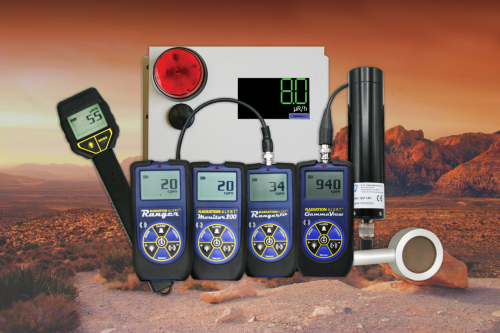
One is a rate meter/general purpose Geiger counter.
This type of instrument shows the rate that
the radiation is being received. The other is
a dosimeter. A dosimeter shows the amount/dose
being received.
When measuring radiation in an emergency response
situation, it is good to have something to compare
your readings to. Taking a background radiations
level in your area before a radiation event,
will help you determine if you have a radiation
elevation and whether or not to stay in that
location. Background radiation is naturally
occurring radiation that is always present.
It includes; high energy gamma rays from the
sun and outer space and alpha, beta, gamma radiation
emitted from elements in the earth. Using a
rate meter, you can determine what your normal
background is.
It is up to the individual to decide what a
safe radiation level is because it differs depending
on the individual and their knowledge of radiation
and its affects. As an example; say your background
level is 25 CPM (counts per minute) where you
live. When you fly in an air plane at 30,000
feet your rate meter is getting 200 CPM for
anywhere between 2 to 5 hours. That is 8 times
what your normal background is on the ground,
but it is for a limited amount of time. There
are non-occupational dose limits set by the
government which is 100 mR per year above background
per year.
What we suggest for a good emergency response
kit for radiation is a general purpose Geiger
counter like the Monitor 4, a carbon fiber dosimeter
such as the PEN200 and a Charger to reset the
dosimeter. There are electronic dosimeters,
however, if you are in the blast zone of a nuclear
bomb the pulse of the bombs render most electronic
inoperable but the carbon style dosimeters will
still operate.
How far away from a source
can I detect it if it is shielded?
Generally, our instruments will detect radiation
up to 18 -24 inches through sheilding.
How often do you recommend
that your instruments need to be calibrated?
We recommend yearly calibrations, although
our instruments hold a stable calibration and
rarely need adjusting.
Possible Household
Sources of Radiation
Smoke Detectors: Some
smoke detectors contain a sealed radioactive
isotope as part of the smoke sensing mechanism.
There is no danger to the individual if
the container in sealed. They are labeled.
Camping Lantern Mantles:
In recent years this has changed but some
lantern mantles are made with radioactive
Thorium. Be especially careful not to
inhale or ingest the fine ash that is
left when they are burned out.
Clocks, Watches, and Timers:
Many old timepieces have dials painted
with radium to make them glow in the dark.
Tritium is now commonly used to obtain
the same effect. Tritium is also radioactive
but emits low energy radiation which cannot
penetrate the lens of the timepiece.
Jewelry: Some gold used
to encapsulate radium and radon for medical
purposes was improperly reprocessed and
entered the market as radioactive rings
and other types of gold jewelry. Some
imported cloisonné being glazed
with uranium oxide exceeds U.S. limits.
Some gems are irradiated by an electron
beam or in an accelerator to enhance their
color. Irradiated gems typically are held
until there is no residual activity remaining.
Rock Collections: Many
natural formations contain radioactive
materials. Hobbyists who collect such
things should vent the rooms in which
these items are stored and be careful
to avoid inhaling the fine dust particles
from these samples.
Pottery: Some types
of pottery are glazed with uranium oxide,
such as Fiesta ware. To the best of our
knowledge, this process has been discontinued,
although some of these pieces are still
in circulation.
Taking Measurements
Geiger counters can detect the four main
types of ionizing radiation: alpha, beta, gamma,
and x-rays. Some detect only gamma and x-rays.
Our instruments are calibrated to Cesium 137,
but also serve as excellent indicators for many
other sources of ionizing radiation. Gamma and
x-rays are measured in milli-Roentgens per hour
(mR/hr), micro-Sieverts (µSv/hr), or milli-Sieverts
(mSv/hr). Alpha and beta are measured in counts
per minute (CPM) or counts per second (CPS).
The window of the GM tube is very thin mica.
This mica window is protected by a screen. Some
levels of alpha, low energy beta, gamma, and
x-rays that cannot penetrate the plastic case
or the side of the tube can be sensed through
the window.
Try not to touch the instrument to any suspected
radioactive substance.
Although some beta and most gamma radiation
can go through protective gear, try to avoid
skin contamination and ingestion. When you leave
a radioactive area, remove any protective outerwear
and dispose of it properly. If you think you
have been contaminated, as an additional precaution,
shower and consult a physician.
To determine whether the radiation detected
is alpha, beta, or gamma, hold the instrument
toward the source.
Alpha: If there is no
indication through the back of the case
(the side of the tube), position the window
close to but not touching the source.
If there is an indication, it is alpha,
beta, or low energy gamma. If a sheet
of paper placed between the window and
the source stops the indication, it is
most likely alpha. To avoid particles
falling into the instrument, do not hold
the source above the window.
Beta: Place a piece
of aluminum about 1/8 inch (3 mm) thick
between the instrument and the source.
If the indication stops, decreases, or
changes, it is most likely beta radiation.
Most common isotopes emit both beta and
gamma radiation. This is why the indication
would decrease or change but not stop.
The non-occupational dose limits set by the
government is 100 mR per year above background
per year.
It is up to the individual to decide what a
safe radiation level is. It will be different
depending on the individual and their knowledge
of radiation and its affects. Radiation levels
will vary according location and circumstances.
As an example; if your background level is 25
CPM (counts per minute) where you live, when
you fly in an airplane at 30,000 feet your rate
meter may measure 200 CPM (.2 mR) for 2 to 5
hours. That is 8 times your normal background
radiation on the ground, but it is only for
a limited amount of time.
When measuring radiation in an emergency response
situation, it is good to have something to compare
your readings to. Taking a background radiation
level reading in your area before a radiation
event will help you determine if you have an
elevated level of radiation and whether or not
to stay in that location. Background radiation
is naturally occurring radiation that is always
present. It includes; high energy gamma rays
from the sun and outer space and alpha, beta,
gamma radiation emitted from elements in the
earth. Using a rate meter, you can determine
your normal background radiation levels.
For a good emergency response kit for radiation
we recommend a general purpose Geiger counter
(like the Monitor 4), a carbon fiber dosimeter
(such as the PEN200) and a Charger to reset
the dosimeter. There are electronic dosimeters,
however, if you were in the blast zone of an
atomic bomb the pulse of the bomb would make
most electronic equipment inoperable. The carbon
style dosimeters will still operate.
Gamma: If there is an
indication of radioactivity, it is most
likely gamma or high energy beta. Low
energy gamma and x-rays (10-40 keV) cannot
penetrate the side of the GM tube, but
may be detected through the window.
If you perform the alpha/beta test above and
there is no change or only a very slight change
in the indication, the source is emitting primarily
gamma radiation.
What is a Typical
Geiger Counter?
A Geiger counter senses ionizing radiation
by means of a GM (Geiger Mueller) tube. Some
tubes have a thin mica window. When a ray or
particle of ionizing radiation enters or passes
through the tube, it is sensed electronically
and displayed on the meter or LCD and by a red
count light. When the switch is in the AUDIO
position, the instrument will also beep with
each radiation event.
What is the MARSSIM
method?
"MARSSIM" is the "Multi-Agency
Radiological Survey and Site Investigation
Manual," a document widely used in
designing and carrying out radiological
surveys in support of license termination.
With the MARSSIM Method the confidence
level is locked in at 95% and 3 is used
for the "k²" value. This
affects, then, only calculations for Ld,
MDA, and LLD. This method was proposed
by Dr.
Alan Brodsky and was adopted in the
MARSSIM manual. In truth, whether the
MARSSIM method or the "traditional"
method (proposed by Lloyd Currie) is used,
very little difference is seen in the
end result. The MARSSIM/Brodsky method
should be more accurate when low background
count rates are present. To match the
MARSSIM methodology and Brodsky recommendations
exactly, the sample counting time and
background counting time should be identical,
although MARSSIM does state that other
methods exist that adjust for these differences.
What types of radiation
do your instruments detect?
Our instruments detect ionizing radiation.
Types of ionizing radiation are Alpha (a), Beta(ß),
Gamma(?), X-ray (?), and Neutron Radiation.
Examples of NON-ionizing radiation are microwaves
and radiowaves.
Why is my instrument
getting readings when there are no sources present?
The instrument is detecting the background
radiation in that area. Background radiation
is naturally occurring radiation all around
us from cosmic radiation and radiation present
in the soil.
Glossary of Terms
Alpha: Positively charged
particles emitted from the nucleus of
an atom. Alpha particles are relatively
large, and very heavy. Due to this strong
(+) charge and large mass, an alpha particle
cannot penetrate far into any material.
A sheet of paper or an inch of air can
usually stop most alpha particles.
Background Radiation:
Naturally occurring radiation is always
present, it includes high energy gamma
rays from the sun and outer space and
alpha, beta, and gamma radiation emitted
from elements in the earth.
Beta Particles: Negatively
charged particles emitted from an atom.
Beta particles have a mass and charge
equal to that of an electron. They are
very light particles (about 2,000 times
less mass than a proton) and have a charge
of -1. Because of their light mass and
single charge, beta particles can penetrate
more deeply than alpha particles. A few
millimeters of aluminum will stop most
beta particles.
Bq (Becquerels): A quantity
of radioactivity in which one atom is
transformed per second. 1 dps (one disintegration
per second).
CPM (counts per minute):
The unit of measurement usually used to
measure alpha and beta radiation.
Gamma Rays: Short wavelength
electromagnetic radiation higher in frequency
and energy than visible and ultraviolet
light. Gamma rays are emitted from the
nucleus of an atom. These high energy
photons are much more penetrating than
alpha and beta particles.
Ion: An atomic particle,
atom, or molecule that has acquired an
electrical charge, either positive or
negative, by gaining or losing electrons.
Ionization: The process
by which neutral atoms of molecules are
divided into pairs of oppositely charged
particles known as ions.
Ionizing Radiation:
Radiation capable of producing ionization
by breaking up atoms or molecules into
charged particles called ions.
Radiation: The emission
and propagation of energy through space
or through matter in the form of particles
or waves.
Roentgen (rent-gen):
A basic unit of measurement of the ionization
produced in air by gamma or x-rays. One
Roentgen (R) is exposure to gamma or x-rays
that will produce one electrostatic unit
of charge in one cubic centimeter of dry
air. One thousand milliroentgen (1,000
mR)= 1R.
Radionuclide: The naturally
occurring or artificially produced radioactive
form of an element.
Sievert: A unit of dose
equivalent. 1 Sv= 100 roentgens, 10 µSv/hr
= 1 milliroentgen/hr. (µSv micro-Sievert,
micro is one millionth, milli is one thousandth.)
X-Rays: Electromagnetic
radiation (photons) of higher frequency
and energy than visible and ultraviolet
light, usually produced by bombarding
a metallic target with high speed electrons
in a vacuum. X-rays are photons emitted
by interactions involving orbital electrons
rather than atomic nuclei. X-rays and
gamma rays have the same basic characteristics.
The only difference between them is their
source of origin.
Other Sources: SciTechEng |